


Minimalist Async Evaluation Framework for R
→ Event-driven core with microsecond messaging
→ Scale from laptop to HPC and cloud — add or remove compute on the fly
→ Built for production — bounded queues, cancellation, distributed tracing

install.packages("mirai")library(mirai)
# Launch 6 background R processes (daemons) to run tasks on
daemons(6)
# mirai() starts an async task and returns immediately
m <- mirai({ Sys.sleep(1); mean(rnorm(1e6)) })
# Task still running, but the console is free
unresolved(m)
#> [1] TRUE
# Async map: [] collects results; options for progress bar and flatmap
mirai_map(1:9, \(x) { Sys.sleep(0.5); x^2 })[.progress, .flat]
#> [1] 1 4 9 16 25 36 49 64 81
# m[] waits for and returns the result
m[]
#> [1] 0.001157286
# Shut down all daemons
daemons(0)mirai() sends tasks to daemons — persistent R
worker processes. The host listens at a URL; daemons dial in and pull
work via an in-process dispatcher thread that handles
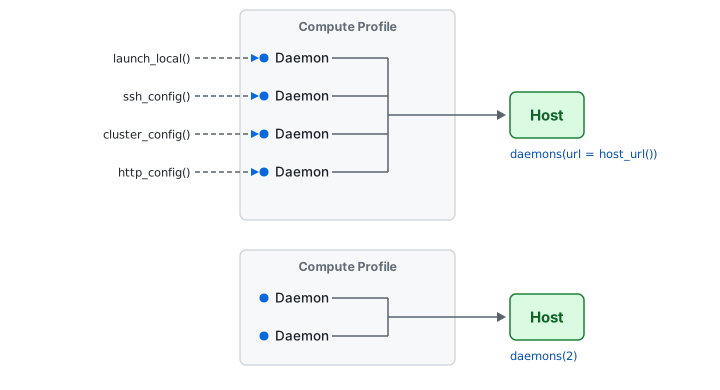
scheduling, cancellation, and bounded queues. Add or remove daemons at
any time, and direct tasks to different compute profiles (CPU
pool, GPU pool, remote cluster) from the same session.
Round-trip latency stays in the microseconds:
daemons(1)
bench::mark(mirai("hello world")[])
#> # A tibble: 1 × 6
#>   expression                      min   median `itr/sec` mem_alloc `gc/sec`
#>   <bch:expr>                 <bch:tm> <bch:tm>     <dbl> <bch:byt>    <dbl>
#> 1 "mirai(\"hello world\")[]"   73.6µs   91.9µs    10301.    9.68KB     4.02
daemons(0)| Where | Setup |
|---|---|
| Local machine | daemons(n) |
| SSH (direct or tunnelled) | ssh_config() |
| HPC scheduler — Slurm, SGE, Torque/PBS, LSF | cluster_config() |
| HTTP API — Posit Workbench, custom | http_config() |
| Anywhere else | remote_config() |
daemons(
  n = 6,
  url = host_url(tls = TRUE),
  remote = cluster_config(options = "#SBATCH --mem=10G")
)
See the reference vignette for the full deployment guide.
mirai(), mirai_map(),
everywhere(), race_mirai(),
try_mirai()m[], collect_mirai(),
call_mirai(), .flat, .progress,
.stopas.promise() for mirai and
mirai_map; event-driven Shiny ExtendedTaskstop_mirai(), .timeout,
.stopdaemons(memory = …) capacity, peak watermark via
status()$memory, non-blocking try_mirai()serial_config() for torch, Arrow, polars, ADBC;
mori::share() for local shared memorydaemons(seed = …) for
deterministic parallel RNGinfo(), status(), OpenTelemetry spans via
otelwith_daemons(),
local_daemons()parallel::makeCluster(type = "MIRAI") (R ≥ 4.5)
mirai has become the shared async layer for the R ecosystem. It’s the
recommended
async backend for Shiny and the only one for plumber2, the engine behind
purrr::in_parallel() and targets pipelines
through crew, and is the first official
alternative communications backend for base R’s
parallel package.
Will Landau for being instrumental in shaping development of the package, from initiating the original request for persistent daemons, through to orchestrating robustness testing for the high performance computing requirements of crew and targets.
Joe Cheng for integrating the ‘promises’ method to work seamlessly within Shiny, and prototyping event-driven promises.
Luke Tierney of R Core, for discussion on L’Ecuyer-CMRG streams to ensure statistical independence in parallel processing, and reviewing mirai’s implementation as the first ‘alternative communications backend for R’.
Travers Ching for a novel idea in extending the original custom serialization support in the package.
Hadley Wickham, Henrik Bengtsson, Daniel Falbel, and Kirill Müller for many deep insights and discussions.
mirai | nanonext | CRAN HPC Task View
AI coding agents: the r-lib agent skill from the posit-dev-skills
plugin provides mirai-specific guidance.
–
Please note that this project is released with a Contributor Code of Conduct. By participating in this project you agree to abide by its terms.