![[ICO]](/icons/blank.gif)
![[PARENTDIR]](/icons/back.gif)
![[TXT]](/icons/text.gif)
![[DIR]](/icons/folder.gif)
| Name | Last modified | Size | Description |
|---|---|---|---|---|
| Parent Directory | - | ||
| README.html | 2026-02-13 10:40 | 32K | |
| man/ | 2026-02-13 10:40 | - | |




Qatar Cars provides a more internationally-focused, modern cars-based
demonstration dataset. It mirrors many of the columns in
mtcars, but uses (1) non-US-centric makes and models, (2)
2025 prices, and (3) metric measurements, making it more appropriate for
use as an example dataset outside the United States. It includes almost
exactly the same variables as the mtcars dataset:
origin: The country associated with the car brandmake The brand of the car, such as Toyota or Land
Rovermodel The specific type of car, such as Land Cruiser or
Defenderlength, width, and height:
Length, width, and height of the car (in meters)seating: Number of seats in the cartrunk: Capacity or volume of the trunk (in liters)economy: Fuel economy of the car (in liters per 100
km)horsepower: Car horsepowerprice: Price of the car in 2025 Qatari riyalsmass: Mass of the car (in kg)performance: Time to accelerate from 0 to 100 km/h (in
seconds)type: The type of the car, such as coupe, sedan, or
SUVenginetype: The type of engine: electric, hybrid, or
petrolThe original data was compiled by Paul Musgrave in January 2025 and is mostly sourced from YallaMotors Qatar. See Paul’s writeup of the background and purpose of the data.
See this article for a more detailed description of the rationale for and process of collecting the data:
Paul Musgrave, “Defaulting to Inclusion: Producing Sample Datasets for the Global Data Science Classroom,” Journal of Political Science Education, 2025, 1–11, https://doi.org/10.1080/15512169.2025.2572320.
The Qatar Cars data is available in several different formats:
This {qatarcars} R package. See below for complete details. Load like this:
library(qatarcars)
qatarcars
Plain text CSV file. Use with any software.
Stata .dta file. Load like this:
use "https://qatarcars.georgetown.domains/qatarcars.dta"
list in 1/6
R .rds file. Load like this:
df <- readRDS("qatarcars.rds")
head(df)
The
QatarCars Python package. Install with
pip install qatarcars, then load like this:
from qatarcars import get_qatar_cars
df = get_qatar_cars("pandas")  # or "polars"
df.head()The released version of {qatarcars} is available on CRAN:
install.packages("qatarcars")You can also install the development version from GitHub:
# install.packages("remotes")
remotes::install_github("profmusgrave/qatarcars")Similar to other data-only R packages like {gapminder} and {palmerpenguins},
load the data by running library(qatarcars):
library(qatarcars)

qatarcars
#> # A tibble: 105 × 15
#>    origin  make     model   length width height seating trunk economy horsepower
#>    <fct>   <fct>    <fct>    <dbl> <dbl>  <dbl>   <dbl> <dbl>   <dbl>      <dbl>
#>  1 Germany BMW      3 Seri…   4.71  1.83   1.44       5    59     7.6        386
#>  2 Germany BMW      X1        4.50  1.84   1.64       5   505     6.6        313
#>  3 Germany Audi     RS Q8     5.01  1.69   2.00       5   605    12.1        600
#>  4 Germany Audi     RS3       4.54  1.85   1.41       5   321     8.7        400
#>  5 Germany Audi     A3        4.46  1.96   1.42       5   425     6.5        180
#>  6 Germany Mercedes Maybach   5.47  1.92   1.51       4   500    13.3        612
#>  7 Germany Mercedes G-Wagon   4.61  1.98   1.97       5   480    13.1        585
#>  8 Germany Mercedes EQS       5.22  1.93   1.51       5   610    NA          333
#>  9 Germany Mercedes GLA       4.41  1.83   1.61       5   435     5.6        163
#> 10 Germany Mercedes GLB 200   4.63  4.63   1.66       5   565     7.5        221
#> # ℹ 95 more rows
#> # ℹ 5 more variables: price <dbl>, mass <dbl>, performance <dbl>, type <fct>,
#> #   enginetype <fct>
[!TIP]
If you have {tibble} installed (likely as part of the tidyverse),
qatarcarswill load as a tibble with nicer printing output; if you do not have {tibble} installed, the data will load as a standard data frame.
See ?qatarcars for data documentation within R.
Prices are stored as Qatari Riyals (QAR). At the time of data collection in January 2025, the exchange rates between QAR and US Dollars and Euros were:
For convenience, this package includes functions for converting between these three currencies based on January 2025 exchange rates:
qar_to_usd() and
qar_to_eur()usd_to_qar() and
usd_to_eur()eur_to_qar() and
eur_to_usd()library(dplyr)
qatarcars |>
mutate(
price_eur = qar_to_eur(price),
price_usd = qar_to_usd(price)
) |>
select(origin, make, model, starts_with("price"))
#> # A tibble: 105 × 6
#> origin make model price price_eur price_usd
#> <fct> <fct> <fct> <dbl> <dbl> <dbl>
#> 1 Germany BMW 3 Series Sedan 164257 39580 45126.
#> 2 Germany BMW X1 264000 63614. 72527.
#> 3 Germany Audi RS Q8 630000 151807. 173077.
#> 4 Germany Audi RS3 310000 74699. 85165.
#> 5 Germany Audi A3 165000 39759. 45330.
#> 6 Germany Mercedes Maybach 1281000 308675. 351923.
#> 7 Germany Mercedes G-Wagon 1011500 243735. 277885.
#> 8 Germany Mercedes EQS 564500 136024. 155082.
#> 9 Germany Mercedes GLA 209500 50482. 57555.
#> 10 Germany Mercedes GLB 200 168997 40722. 46428.
#> # ℹ 95 more rowsConversions between SI (International System) units (i.e. meters, grams, liters) and US customary units (i.e. feet, pounds, gallons) are not included as functions. This is a deliberate pedagogical choice. The data is designed to be universally inclusive with SI units used by the majority of the world. Users who work with US customary units should convert them on their own.
The “Unit conversions” vignette includes guidance and examples for making these different conversions, since not all of the variables involve straightforward multiplication.
Another benefit of not including built-in conversion functions like
m_to_ft() is that this data can be used to teach learners
how to write R functions:
m_to_ft <- function(meters) {
  meters * (1 / 0.3048)
}

m_to_ft(100)
#> [1] 328.084The official colors of the Qatari flag are white and Pantone
1955 C, or “Qatar maroon.” The hex representation of this color is
#8A1538.
For convenience, this is included as qatar_maroon:
qatar_maroon
#> [1] "#8A1538"

scales::show_col(qatar_maroon)
Most columns in qatarcars are labeled:
attributes(qatarcars$economy)
#> $label
#> [1] "Fuel Economy (L/100km)"
These labels are visible in RStudio’s Viewer panel:

If you use {ggplot2} v4.0+, these variable labels will automatically appear in plot labels:
library(ggplot2)

ggplot(qatarcars, aes(x = economy)) +
  geom_histogram(binwidth = 1, fill = qatar_maroon, color = "white")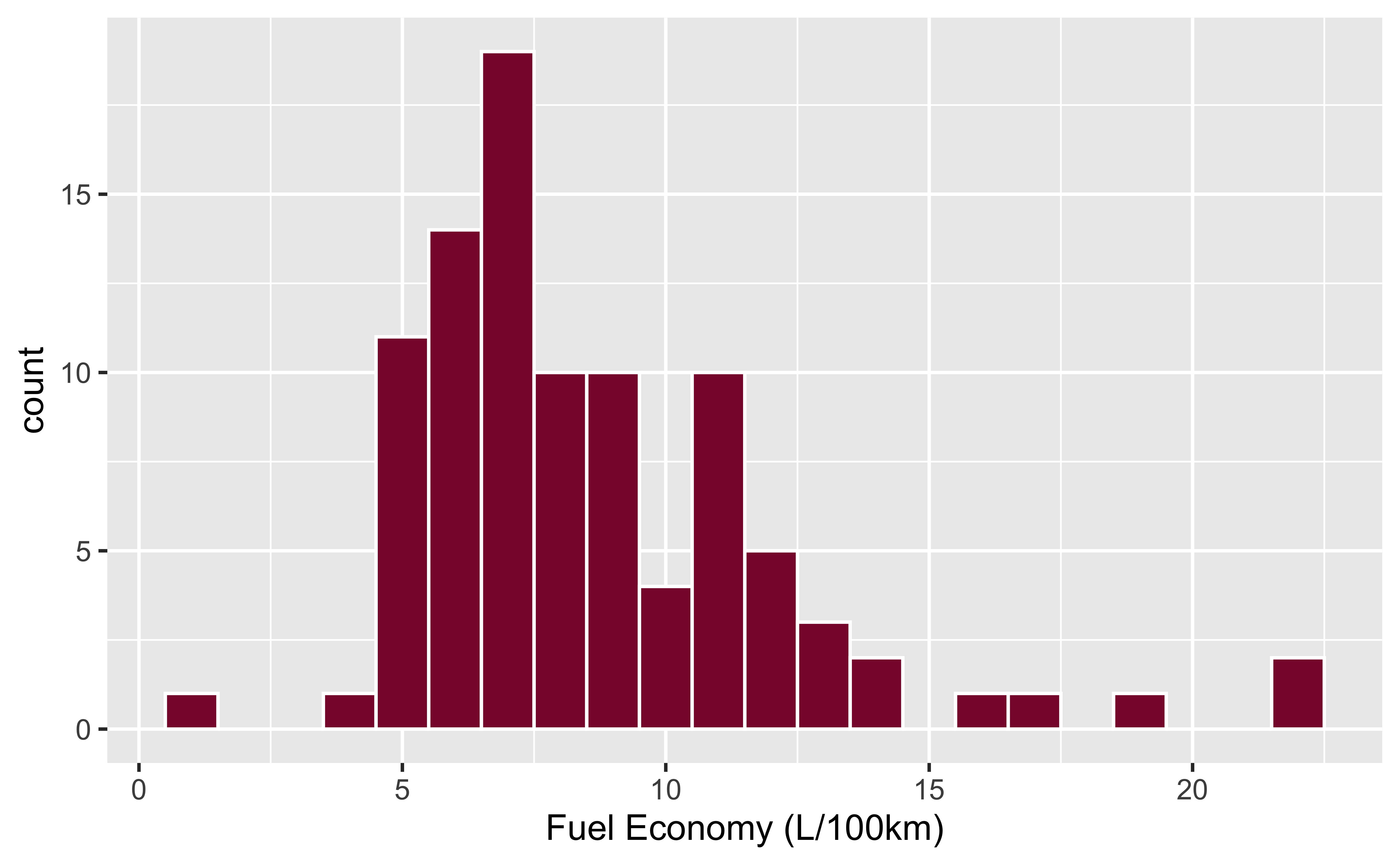
The various conversion functions also update the labels:
qatarcars |>
  mutate(price_eur = qar_to_eur(price)) |>
  ggplot(aes(x = price_eur)) +
  geom_histogram(bins = 20, fill = qatar_maroon, color = "white")  +
  scale_x_log10(labels = scales::label_currency(prefix = "€"))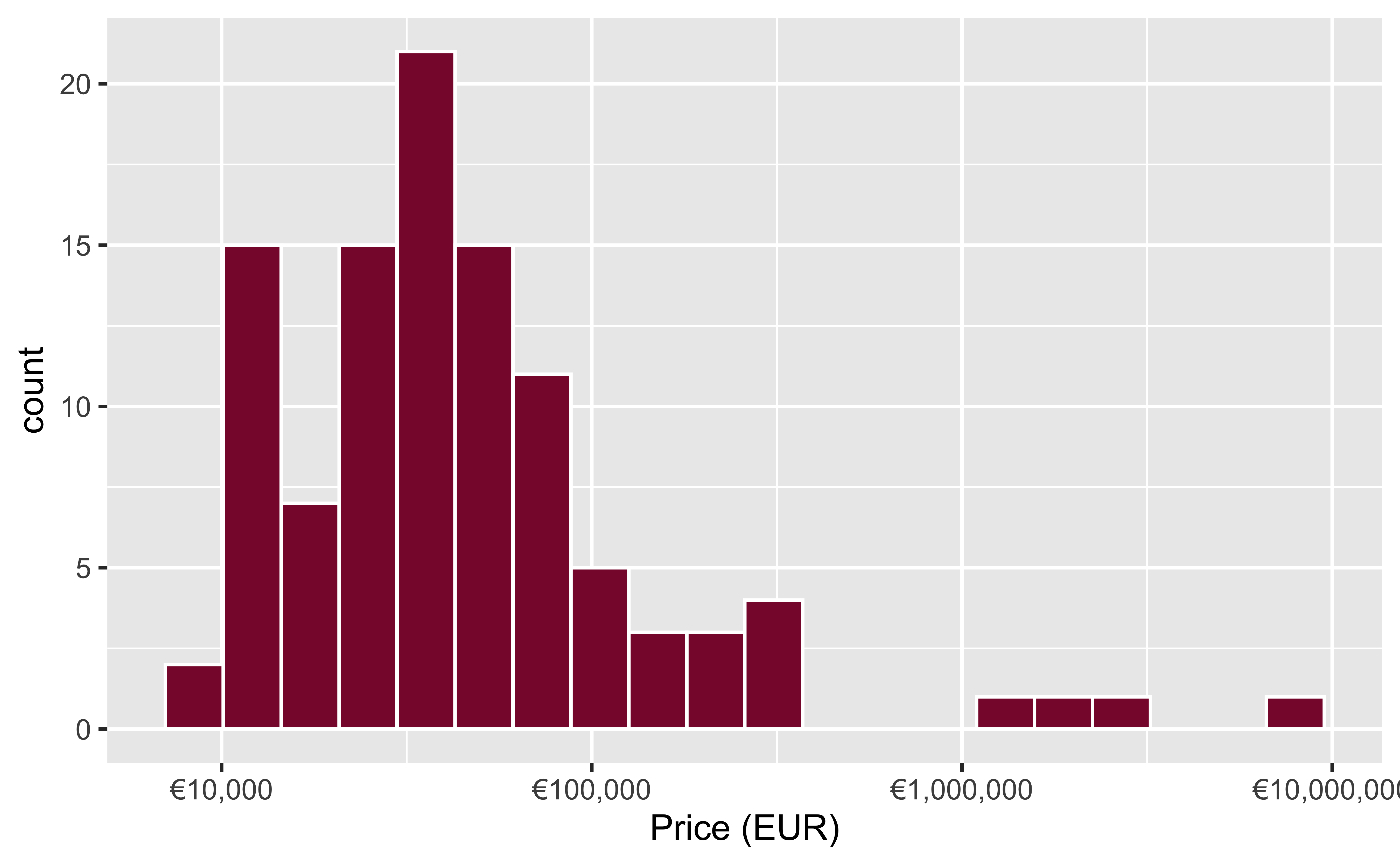
Fuel efficiency gets worse as cars get heavier:
ggplot(qatarcars, aes(x = mass, y = economy)) +
  geom_point() +
  geom_smooth(method = "lm") +
  scale_x_continuous(labels = scales::label_comma())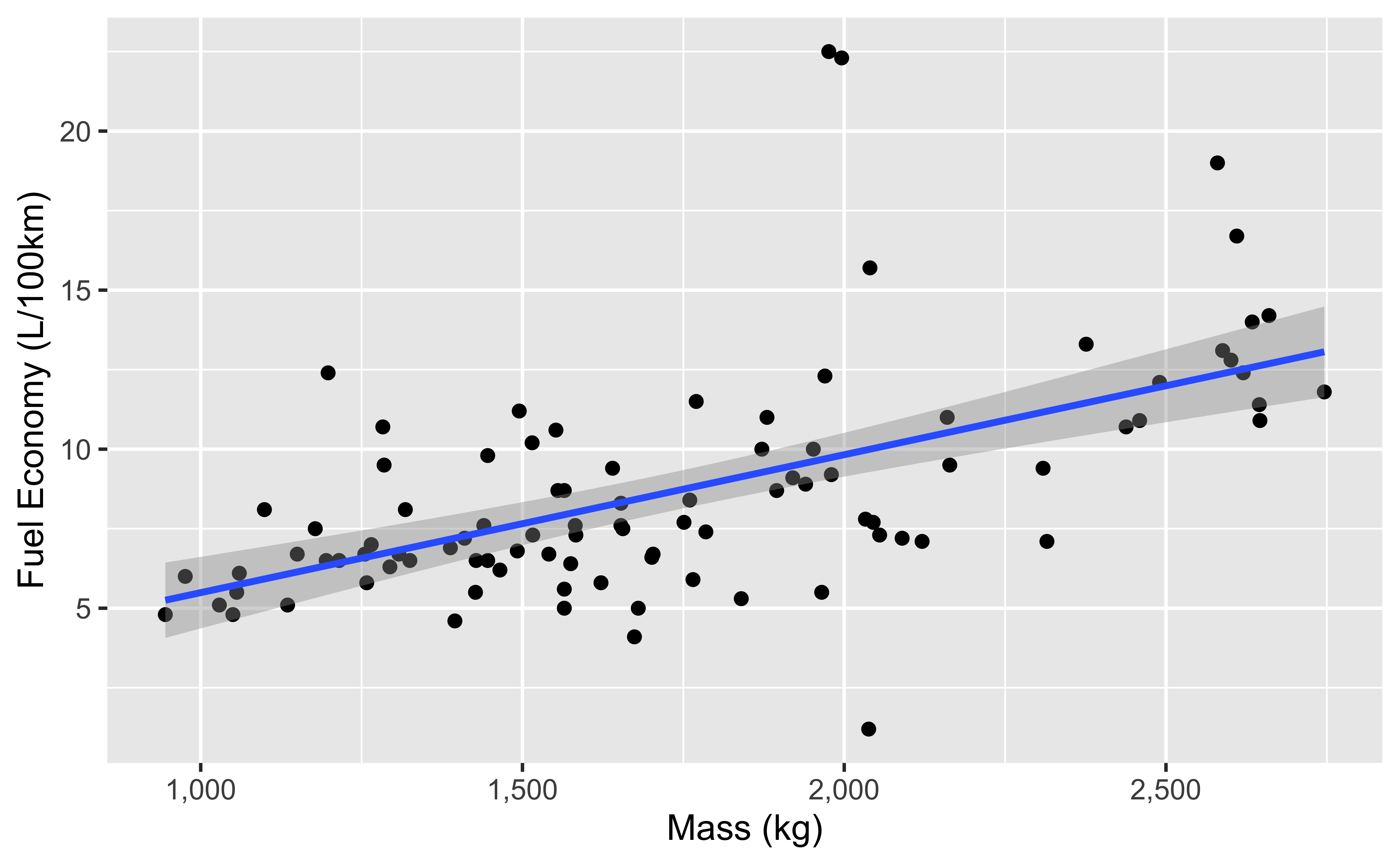
This is reversed when looking at miles per gallon. In SI units, low
economy values are good; in US customary units, high
economy values are good:
economy_conversion_factor <- 100 *
  3.785411784 / # liters in a gallon
  (0.3048 * 5280 / 1000) # kilometers in a mile

qatarcars |>
  mutate(
    mass_lbs = mass / 0.45359237,
    economy_mph = economy_conversion_factor / economy
  ) |>
  ggplot(aes(x = mass_lbs, y = economy_mph)) +
  geom_point() +
  geom_smooth(method = "lm") +
  scale_x_continuous(labels = scales::label_comma()) +
  labs(x = "Mass (lbs)", y = "Fuel Economy (mpg)")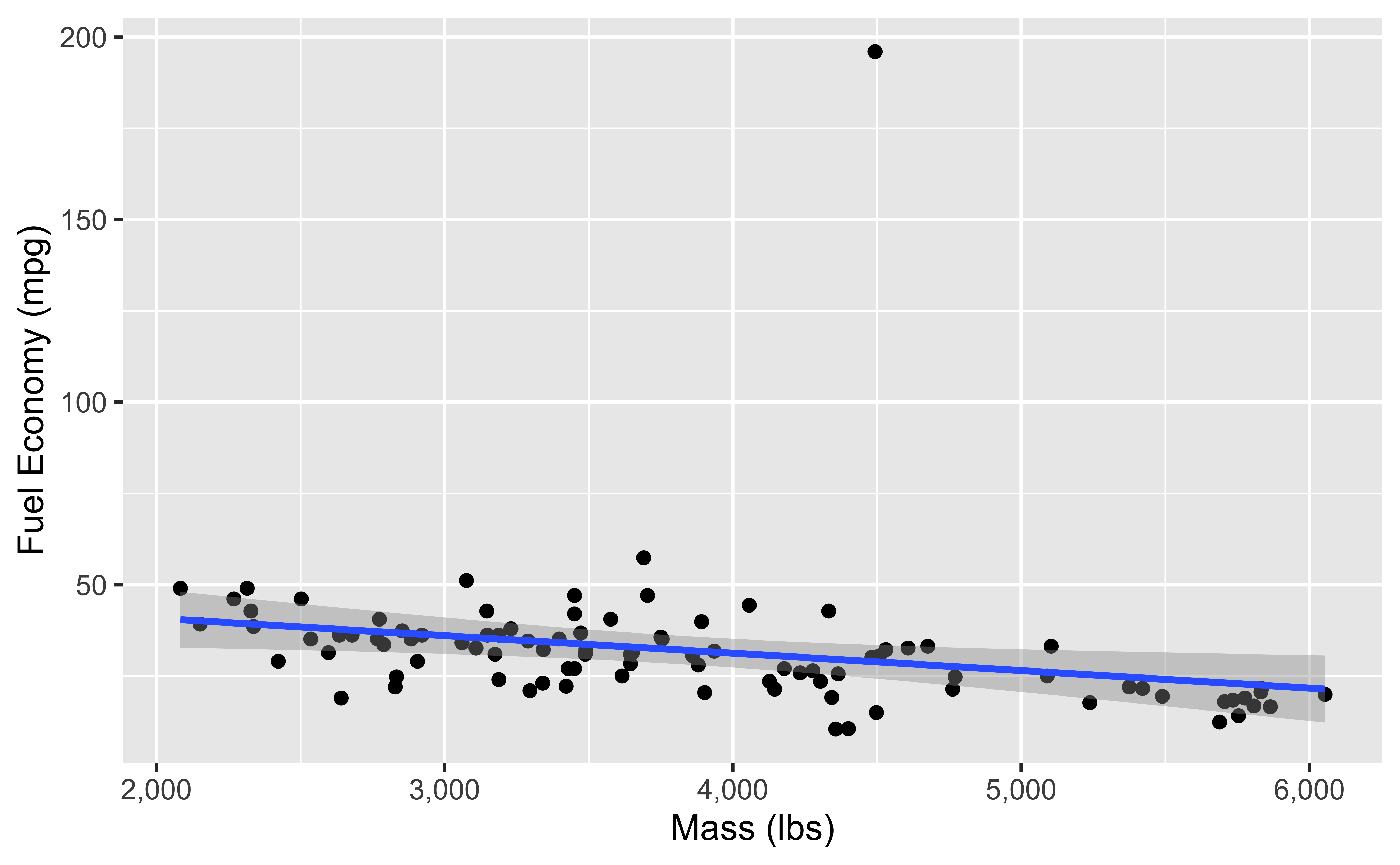
Some of these cars are really expensive, so logging the price is helpful:
ggplot(qatarcars, aes(x = performance, y = price)) +
  geom_smooth() +
  geom_point(aes(color = type)) +
  scale_y_log10(labels = scales::label_currency(prefix = "QR "))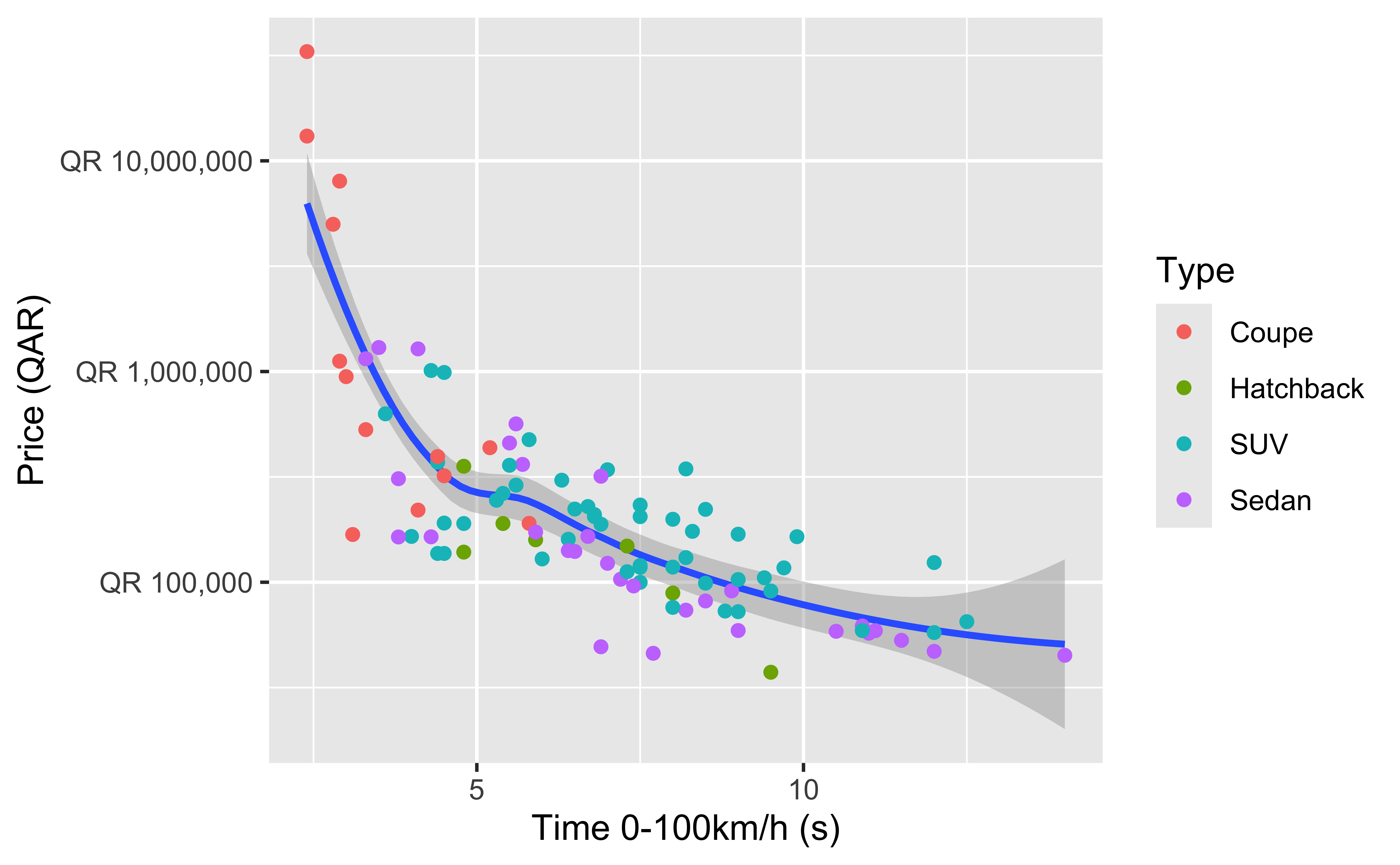
Or in dollars:
qatarcars |>
  mutate(
    price_usd = qar_to_usd(price),
    performance_mph = performance * (0.3048 * 5280 * 60 / 1000 / 100)
  ) |>
  ggplot(aes(x = performance_mph, y = price_usd)) +
  geom_smooth() +
  geom_point(aes(color = type)) +
  scale_y_log10(labels = scales::label_currency(prefix = "$")) +
  labs(x = "Time 0-60 mph (s)")